
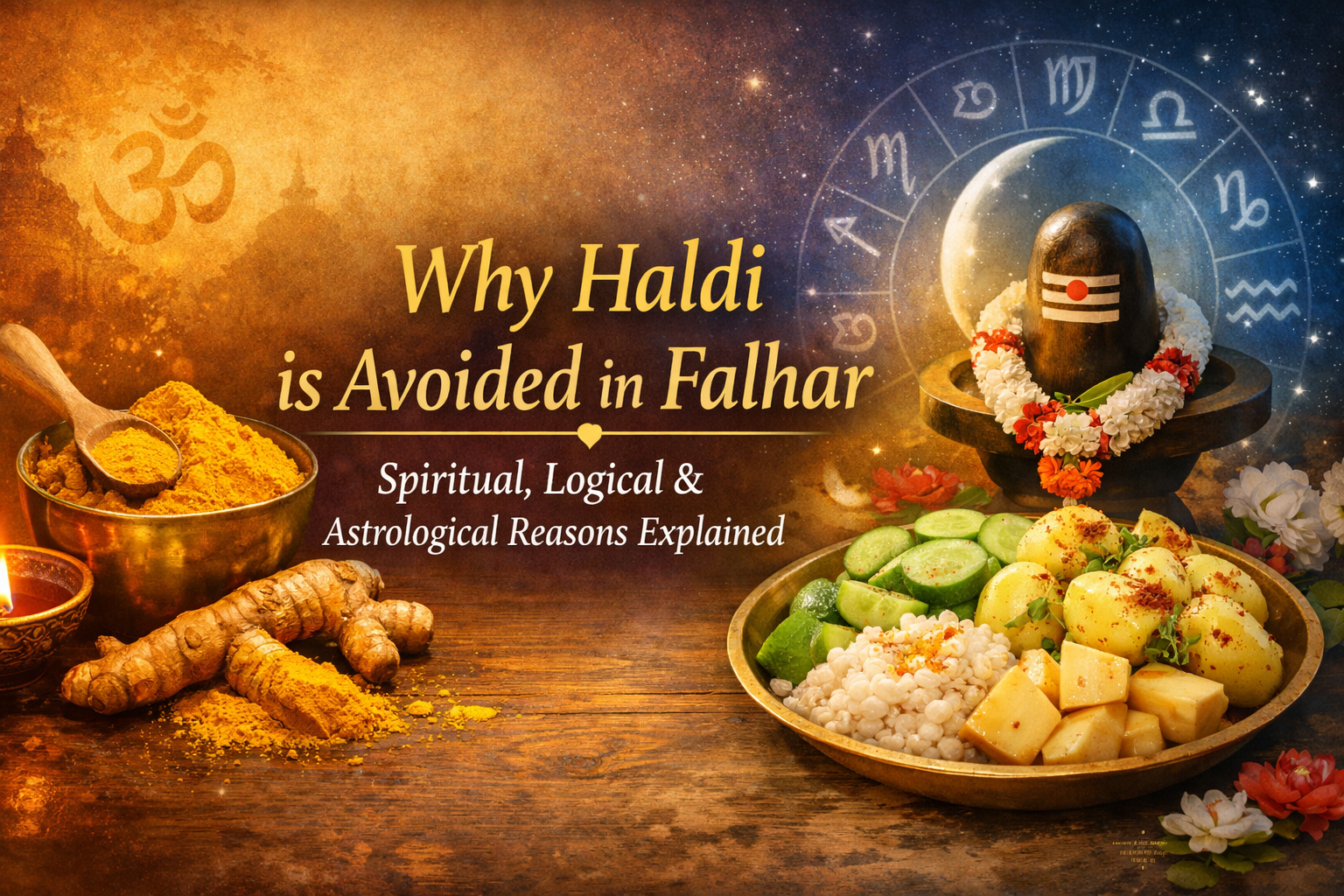
When we observe fasts like Maha Shivratri, Navratri, Ekadashi, or Shravan Somvar, many of us carefully prepare Falhar meals—simple, sattvic food meant for purity and devotion.
Yet, a common question arises:
If Haldi (turmeric) is so auspicious and healing, why is it traditionally avoided in Falhar food?
Let us explore the answer through spiritual wisdom, practical logic, and astrological insight.
— ✦ —
The Sacred Role of Haldi in Indian Tradition
Haldi holds a deeply respected place in Indian culture:
- Used in weddings and religious rituals
- Applied in pujas and purification ceremonies
- Known for its healing and immunity-boosting properties
- Symbol of prosperity, protection, and divine grace
Spiritually, Haldi represents Shakti (active energy) and transformation.
So naturally, its absence in Falhar seems confusing—until we understand its deeper purpose.
— ✦ —
The Spiritual Reason: Fasting Is About Stillness, Not Stimulation
Fasting is not only about skipping meals. It is about:
- Calming the senses
- Purifying thoughts
- Turning inward
- Connecting with the Divine
Haldi is considered Ushna (heating) in nature. It stimulates:
- Digestion
- Blood circulation
- Metabolism
- Physical energy
During fasting, the body is meant to remain light, calm, and inward-focused.
Adding Haldi activates the body’s energy system, which goes against the spiritual intention of fasting.
Key Insight:
Fasting is about silence of the body and mind. Haldi awakens activity.
— ✦ —
The Ayurvedic Logic: Haldi Activates Digestion
According to Ayurveda, Haldi is a powerful digestive stimulant.
It:
- Increases digestive fire (Agni)
- Speeds up metabolism
- Encourages appetite
- Enhances absorption
During Falhar:
- Digestion is intentionally slowed
- The stomach is kept light
- The body is in detox mode
Using Haldi may:
- Trigger hunger
- Cause acidity
- Disturb gut balance
- Create heaviness
This is why Falhar foods are limited to:
- Fruits
- Potatoes
- Sabudana
- Milk
- Nuts
- Rock salt
These are easy to digest and non-stimulating.
Practical Reason:
Haldi makes the body work harder when it is meant to rest.
— ✦ —
The Astrological Perspective: Energy Alignment During Fasting
In Vedic astrology, fasting days are ruled by strong planetary and spiritual energies.
For example:
- Maha Shivratri → Shiva Tattva (stillness, transcendence)
- Ekadashi → Vishnu Tattva (purity, balance)
- Navratri → Devi Tattva (discipline, devotion)
On these days, the body aligns with:
- Higher frequencies
- Subtle energies
- Spiritual vibrations
Haldi is associated with Mars and Sun energy—fiery, active, dynamic.
These energies are wonderful for:
- Daily life
- Work
- Healing
- Strength
But during fasting, we aim for:
- Moon-like calmness
- Saturn-like discipline
- Jupiter-like wisdom
Adding Haldi introduces excess fire, disturbing this balance.
Astrological Insight:
Fasting seeks cooling, grounding energy. Haldi brings heat and activation.
— ✦ —
Why Haldi Is Used in Rituals but Not in Falhar
This is an important distinction.
In Rituals:
Haldi is used for:
- Cleansing energy
- Removing negativity
- Blessing beginnings
- Protection
It works on the energetic and spiritual level.
In Food:
Haldi works on the physical and digestive level.
During fasting:
- We want spiritual activation
- Not physical stimulation
So Haldi is honored in worship, but limited in consumption.
Cosmic Reminder:
Not every sacred item is meant for every spiritual practice.
— ✦ —
The Psychological Aspect: Discipline and Mind Control
Fasting also trains the mind.
Avoiding spices like Haldi helps:
- Reduce craving
- Control taste addiction
- Practice detachment
- Increase willpower
Simple food = focused mind.
Spicy food = distracted mind.
This mental discipline is one of the biggest hidden benefits of vrat.
— ✦ —
When Can Haldi Be Taken During Fasting?
In certain situations, Haldi is allowed in medicinal form:
- Haldi milk for weakness
- Haldi with honey for immunity
- Haldi water for healing
But this is considered remedy, not food.
It is taken with intention, not indulgence.
— ✦ —
Soul Tip: The Deeper Meaning of Falhar
Falhar is not about “what we can eat.”
It is about:
- What we can release
- What we can simplify
- What we can surrender
When you skip Haldi on fasting days, you are subconsciously saying:
“I choose inner peace over outer pleasure.”
That is true devotion.
— ✦ —
Final Reflection
Haldi is sacred.
Haldi is healing.
Haldi is powerful.
But fasting is about quiet power, not active power.
That is why tradition wisely keeps Haldi out of Falhar food—
to protect your body, mind, and spiritual alignment.
Sometimes, spirituality is not about adding more.
It is about knowing when to pause.
— ✦ —
Key Takeaway
Avoiding Haldi in Falhar is:
✔ Spiritually grounding
✔ Ayurvedically balanced
✔ Astrologically aligned
✔ Mentally strengthening
It is a conscious practice, not a restriction.
— ✦ —
With love & cosmic guidance,
Himani Goyal Soul Studio
🌐 himanigoyal21.com



Leave a Reply