
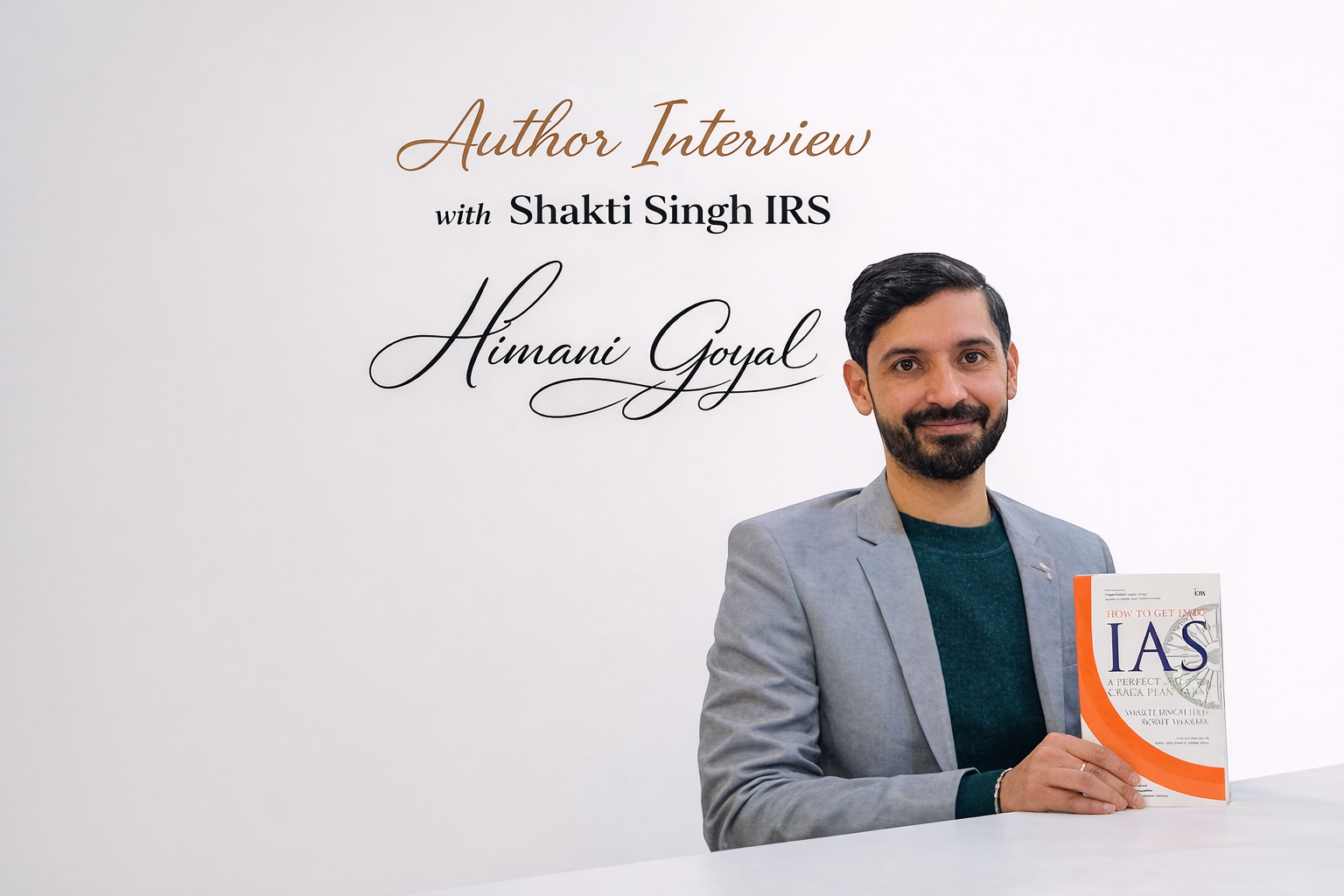

Q1. Tell us Something About yourself.
Shri. Shakti Singh: I am Shakti Singh from Muzaffarnagar in Uttar Pradesh. I come from a rural background and completed my graduation from Muzaffarnagar. After graduation, I faced a setback that forced me to take a break from my studies and career preparation. It was a challenging phase, but I eventually got back on track.
I cleared a few competitive exams including Bank PO, LIC AAO and SSC, and joined the erstwhile State Bank of Patiala as a Probationary Officer. Later, I joined the Income Tax Department as an Inspector. While working there, I interacted with IRS officers and felt inspired to appear for the Civil Services Examination conducted by UPSC.
I cleared CSE 2013 and became a 2014 batch officer of the Indian Revenue Service. I am currently serving as Joint Commissioner of Income Tax in Chandigarh.
Q2. Every meaningful book has a journey behind it. What were some of the biggest struggles you personally faced during your own preparation or professional journey that shaped your perspective on the IAS exam?
Shri Shakti Singh: The idea of appearing for the Civil Services Examination was in my mind for quite some time, but personal setbacks had shaken my confidence, and I hesitated to take the attempt. Working closely with IRS officers later reignited that aspiration and I finally decided to prepare seriously.
One of my biggest struggles was the lack of reliable information and proper guidance, especially while managing a full-time job. I did not know where to begin. The common approach was to pick up popular books, collect market notes and start studying without clarity. Myths and misinformation about the exam further complicated things. There was also very little guidance on service preferences and how they can shape one’s long-term career.
I was fortunate to have a few seniors to guide me, but many aspirants, particularly from rural backgrounds, do not have that support. This personal struggle led to the idea of writing this book. The intention was simple: to provide clear, authentic information in an accessible form and to guide aspirants through every stage of the journey. That’s where Rohit came into the picture. His experience as a bestselling author helped shape my thought into a book that will not only provide authentic information about the CSE but also act as a constant guide and motivator for an aspirant in his or her long and challenging journey, from deciding to appear for CSE to starting preparation, staying consistent, reaching final selection, and even beyond.
Q3. Was there a moment during your journey when you felt like giving up? How did you overcome that phase, and what kept you moving forward?
Shri Shakti Singh: Success in this examination did not come easily to me. Like many aspirants, I faced failures at different stages. They were discouraging, but not strong enough to stop me from trying again.
The most difficult phase was after I failed to make it to the final list in the 2012 examination. That setback was hard to accept, and for a while the thought of giving up did cross my mind. It felt exhausting to invest so much effort and still fall short.
During that time, the encouragement and perspective shared by a few seniors and close friends helped me regain clarity. I reassessed my preparation honestly and identified the gaps that may have led to the earlier result. Instead of reacting emotionally, I chose to reflect calmly. After that assessment, I decided to give myself one more sincere attempt.
That decision made all the difference.
Q4. Many aspirants struggle silently with self-doubt and pressure. Did you experience similar emotional or mental challenges, and how did they influence your approach to this book?
Shri Shakti Singh: When results do not come initially, it is natural for self-doubt to creep in. Simply deciding to appear for this examination and preparing seriously brings its own pressure. Early failures only add to that burden.
Each person responds to self-doubt and failure differently. I experienced those emotions as well. However, I consider myself fortunate in one way. Struggle has always been a part of my journey, and over time it became second nature. I firmly believe in the saying, “What does not kill me makes me stronger.” Every failure, if analysed honestly, reveals what was missing in one’s preparation. When that insight is used correctly, it becomes a stepping stone to success.
This book is an attempt to support aspirants during such phases. Whether someone is just beginning preparation or has faced setbacks along the way, the aim is to provide clarity, direction and encouragement to move forward.
Q5. At what point did you feel that there was a strong need for a book like IAS? What gaps did you notice in existing preparation material?
Shri Shakti Singh: It was during my own preparation phase that I felt the absence of a proper guiding book for aspirants. There is no shortage of study material for General Studies, optional subjects, ethics, essay writing or language papers. However, there is a clear gap when it comes to structured and reliable guidance.
I realised that while content is available in abundance, clarity is not. There is hardly any resource that handholds an aspirant through the different stages of this demanding journey called CSE. In many cases, the decision to appear for this examination is taken without a clear understanding of what it truly involves.
For a large number of candidates, the Civil Services Examination is synonymous only with the IAS, and even within that, only with the post of District Collector. The reality is far broader. This gap in awareness and structured guidance made me feel that a book addressing these aspects was necessary.
Q6. Most IAS books focus heavily on syllabus and strategy. What made you feel that aspirants needed more than just technical guidance?
Shri Shakti Singh: Continuing from my earlier point, most books available in the market tell aspirants what to study and sometimes how much to study. That is important, but it is not sufficient. Very few resources address how to study for this examination and, more importantly, why to pursue it in the first place.
This book has a dedicated chapter on the question of “why.” Unless an aspirant has a clear answer to why they want to appear for the Civil Services Examination, sustaining motivation becomes difficult. Clarity of purpose strengthens perseverance.
The next important aspect is “how.” The demands of this examination are very different from school or university exams, even for those who have performed well academically. This book attempts to help candidates build a structured study plan suited to the nature of the exam and stay consistent throughout the journey. It is meant to serve as a guide that aspirants can refer to at any stage of their preparation.
Q7. How does this book aim to support aspirants who come from non-metro cities or lack access to top coaching institutions?
Shri Shakti Singh: I hope that my own background, coming from a non-metro area and clearing the examination without formal coaching, serves as encouragement to such aspirants. Today, digital platforms have reduced the gap between metro and non-metro candidates to some extent. Access to lectures and material is no longer limited by geography.
However, the rapid growth of coaching institutes and online influencers has created new challenges. Many platforms focus more on marketing than on genuine guidance. Aspirants, especially those from rural or small-town backgrounds, may find it difficult to distinguish between quality guidance and noise. This is not because they are gullible, but because reliable information and mentorship are often missing.
This book attempts to bridge that gap. It aims to help aspirants identify what truly matters, differentiate quality material from distractions, and save valuable time and effort during preparation.
Q8. What was your personal vision while co-authoring this book? What did you want readers to feel after reading it?
Shri Shakti Singh: As I mentioned earlier, the idea for this book arose from the absence of any structured material that could guide an aspirant through the complexities of this demanding examination. The exam is already highly competitive and challenging. Aspirants should not have to struggle additionally with confusion, misinformation, lack of guidance or absence of motivation.
Many candidates silently deal with self-doubt and pressure. Not everyone has someone they can turn to during such phases, and not everyone finds it easy to open up about their struggles. This book is an attempt to fill that void and serve as a steady guide for every aspirant.
My sincere wish is that after reading this book, an aspirant feels understood. I hope they feel that someone recognises what they are going through. Ideally, most of their questions about the examination will either be answered or they will at least know where to find the right answers.
Q9. Which section or idea in the book is closest to your heart, and why?
Shri Shakti Singh: This book has been written keeping in mind several questions that aspirants often struggle to find answers to. Many of these questions consume a great deal of time and effort during preparation. It is therefore difficult to single out one idea or section as a favourite, because each chapter has been written with equal thought and care.
However, if I had to choose one, I would mention Chapter 6, “Tips to Prepare.” This chapter is closest to my heart because it reflects much of my personal experience as an aspirant. In many ways, it brings together the practical lessons I learned during my journey. It is meant to act as a guide and motivator, something I personally felt was missing during my own preparation phase.
Q10. How does your real-life experience reflect in the advice and structure of this book?
Shri Shakti Singh: This entire book is shaped by my real-life experiences and struggles. Many of the chapters come directly from lessons I learned during my own preparation journey.
For instance, the chapter on “Myths and Truths” was included because I, too, had heard and initially believed several misconceptions about the examination. That misunderstanding cost me valuable time. Similarly, the chapter on choosing an optional subject reflects my own mistake. My initial decision was influenced more by what was popular rather than careful analysis of suitability.
In many ways, each chapter is connected to some phase of my journey, including the errors I made and the insights I gained. The structure and advice in this book are not theoretical. They are drawn from practical experience.
Q11. Failure is often part of the IAS journey. What is the most important lesson failure taught you that aspirants must understand early?
Shri Shakti Singh: Failure, or as I prefer to call it, not getting the desired result, is a part of almost everything we do in life, not just the Civil Services Examination. It is a natural process of growth.
If you observe a child learning to walk, she stumbles at almost every step. Yet she does not stop trying. She gets up, walks again and may fall again. What is remarkable is that through this entire process, the child remains excited and often smiling. There is no fear of falling, only eagerness to move forward.
That enthusiasm is what keeps her going. I believe aspirants should carry the same spirit in their preparation. Work hard, analyse mistakes, learn from setbacks, but do not lose the enthusiasm to continue. Consistency with a positive mindset makes the journey sustainable.
Q12. How can aspirants reframe failure so that it becomes a tool for growth rather than discouragement?
Shri Shakti Singh: I prefer to use the phrase “not getting the desired result” instead of the word “failure.” In essence, that is what it is. We set a goal, we worked towards it, but the outcome was not what we expected. When we reframe it this way, it becomes easier to process and analyse calmly.
If we simply say, “I have failed,” it often feels like a personal flaw. It creates a sense that something is inherently wrong with us. However, when we say that we did not get the desired result, it encourages us to ask why. It shifts the focus from self-doubt to self-assessment.
One honest possibility is that our efforts were not yet sufficient to make us deserving of that result. That understanding is empowering rather than discouraging. It tells us that improvement is within our control. Once this lesson is internalised, it becomes a guiding principle not only for this examination but for any goal in life.
Q13. What are the three most common mistakes you see IAS aspirants making today?
Shri Shakti Singh: 1. Focusing excessively on the number of hours studied.
Many aspirants measure preparation by hours rather than effectiveness. In this examination, quality matters far more than quantity. Focused and productive study is what makes a difference.
2. Worrying about factors beyond one’s control.
During my preparation, I was also guilty of engaging in discussions about issues like scaling or which optional subject was scoring higher in a particular year. Such conversations may sound intellectual, but they are largely unproductive. They consume time and create unnecessary anxiety without improving preparation.
3. Neglecting answer writing practice.
Many candidates study extensively, prepare detailed notes and revise thoroughly, yet do not devote enough time to writing practice. Without practicing answers in real exam conditions, even strong knowledge may not translate into marks. Especially in the weeks leading up to the Mains examination, consistent answer writing in exam format becomes essential.
Q14. With increasing competition, how can aspirants stay focused without comparing themselves constantly with others?
Shri Shakti Singh: While preparing for the Civil Services Examination, the first competitor one must face is oneself. This is true not only for this exam but for most areas of life. We cannot control what others are doing. Worrying about someone else’s level of preparation or the advantages they may have does not contribute to our own progress.
An aspirant must focus on what is within his or her control. This includes an honest assessment of strengths and weaknesses, a practical plan to strengthen strong areas and improve weaker ones, and the discipline to follow that plan consistently.
During preparation, one interacts with many people such as co-aspirants, teachers and mentors. It is important to decide how much time and mental space to give to these interactions. Not everyone who appears knowledgeable offers useful guidance. Similarly, selection alone does not automatically make someone a good mentor, and lack of selection does not mean lack of insight. Choosing the right influences carefully is essential to staying focused.
Q15. What role do discipline and consistency play compared to intelligence or talent in clearing the IAS exam?
Shri Shakti Singh: In my experience, discipline and consistency can outperform intelligence or talent. The reverse is rarely true. Talent may give someone an initial advantage, but without sustained effort it does not translate into results.
The example of Panini, the author of the Ashtadhyayi, is often cited as a powerful illustration of how relentless discipline and dedication can create extraordinary outcomes. While I do not compare myself to such a legendary scholar, my own success in the Civil Services Examination is, in many ways, a result of consistent and structured effort rather than exceptional brilliance.
By consistency, I do not mean stretching preparation indefinitely. I mean working regularly, following a realistic plan and avoiding procrastination. Small, steady efforts over time are far more effective than bursts of intense but irregular study.
Q16. Preparation is long and exhausting. What daily habit or mindset shift would you strongly recommend to aspirants?
Shri Shakti Singh: All meaningful goals demand perseverance, and the Civil Services Examination is no exception. The reward that comes with clearing this exam cannot be measured in ordinary career terms. To achieve such a goal, sustained and wholehearted effort is necessary. Half measures rarely work.
Preparing seriously for one to two years, especially during one’s formative years, can be exhausting. That is why a shift in mindset becomes important. The first anchor should always be clarity of purpose. Why did I choose this path? If the answer to that question is clear and honest, it becomes a strong source of motivation during difficult phases.
The second is to focus on small but measurable improvements in preparation. Instead of feeling overwhelmed by the length of the journey, look at the progress already made while keeping the larger goal in sight. When we acknowledge how far we have come, even a demanding journey begins to feel manageable.
Q17. How important is mental health during preparation, and what are some simple ways aspirants can take care of it?
Shri Shakti Singh: As we are well aware, this exam is one of the toughest, and serious preparation does take its toll on the mental wellbeing of an aspirant. To stay in top mental condition is a must if one has to have any chance of getting the desired result. Without being in a stable mental state, no matter the amount of hard work or time one puts in, or how intelligent or even a genius one is, it will be impossible to clear the different stages. For taking care of mental health, every aspirant can have different methods. I’ll suggest finding ways to let your hair down and never letting the competition get the better of you in your mind.
Q18. If an aspirant is reading this book after multiple unsuccessful attempts, what message would you like to give them?
Shri Shakti Singh: Being one such aspirant myself, I do fully understand and empathize with every such person. My message is simple: make an honest assessment of where you stand vis-à-vis your starting point, do a SWOT analysis, and decide. Don’t cling to any ideas or methods if they don’t produce the desired result, no matter how popular they are, whether they worked for others, or whether they worked for you elsewhere. You haven’t got the desired result, which means that some part of your strategy is not fitting the puzzle of this exam. Identify that and make changes.
Q19. In one sentence, what does clearing IAS truly represent beyond an exam or a rank?
Shri Shakti Singh: Though it is impossible for me to describe it in one sentence still here is how best I can summarize it. Clearing this examination represents not merely a career or a rank, but the opportunity to positively impact the lives of citizens throughout one’s professional journey.
Q20. What would you say to someone who dreams of becoming an IAS officer but doubts whether they are “good enough”?
Shri Shakti Singh: I want to say this clearly so that there is no doubt in the minds of aspirants. Not everyone who clears this examination was a high academic achiever. There may be some, but they are certainly not the majority. Many successful candidates are what we would ordinarily describe as average students.
What matters far more than past academic record is sincerity of purpose and willingness to work hard. If someone genuinely holds this dream and is ready to put in the consistent effort required, they have every chance of success.
The real requirement is the determination to transform the feeling of “not good enough” into steady improvement. With honest effort and persistence, that transformation is always possible.
Q21. Finally, if this book could change just one thing in an aspirant’s journey, what would you want that change to be?
Shri Shakti Singh: This book aims to bring clarity at different stages of an aspirant’s journey, so the change it creates may vary from person to person. For a fresh aspirant, it may provide a clear answer to the question, “Why IAS?” For a parent considering the Civil Services Examination as an option for their child, it may help them decide whether it is the right path. For someone who has not yet achieved the desired result, it may guide them towards small but meaningful changes in preparation strategy. The impact of the book will differ depending on where a person stands in their journey. If it can replace confusion with clarity and doubt with informed decision-making, even in one important area, that would be meaningful change.
Book Available on Amazon: https://amzn.in/d/0gWpHcQ4


Leave a Reply