
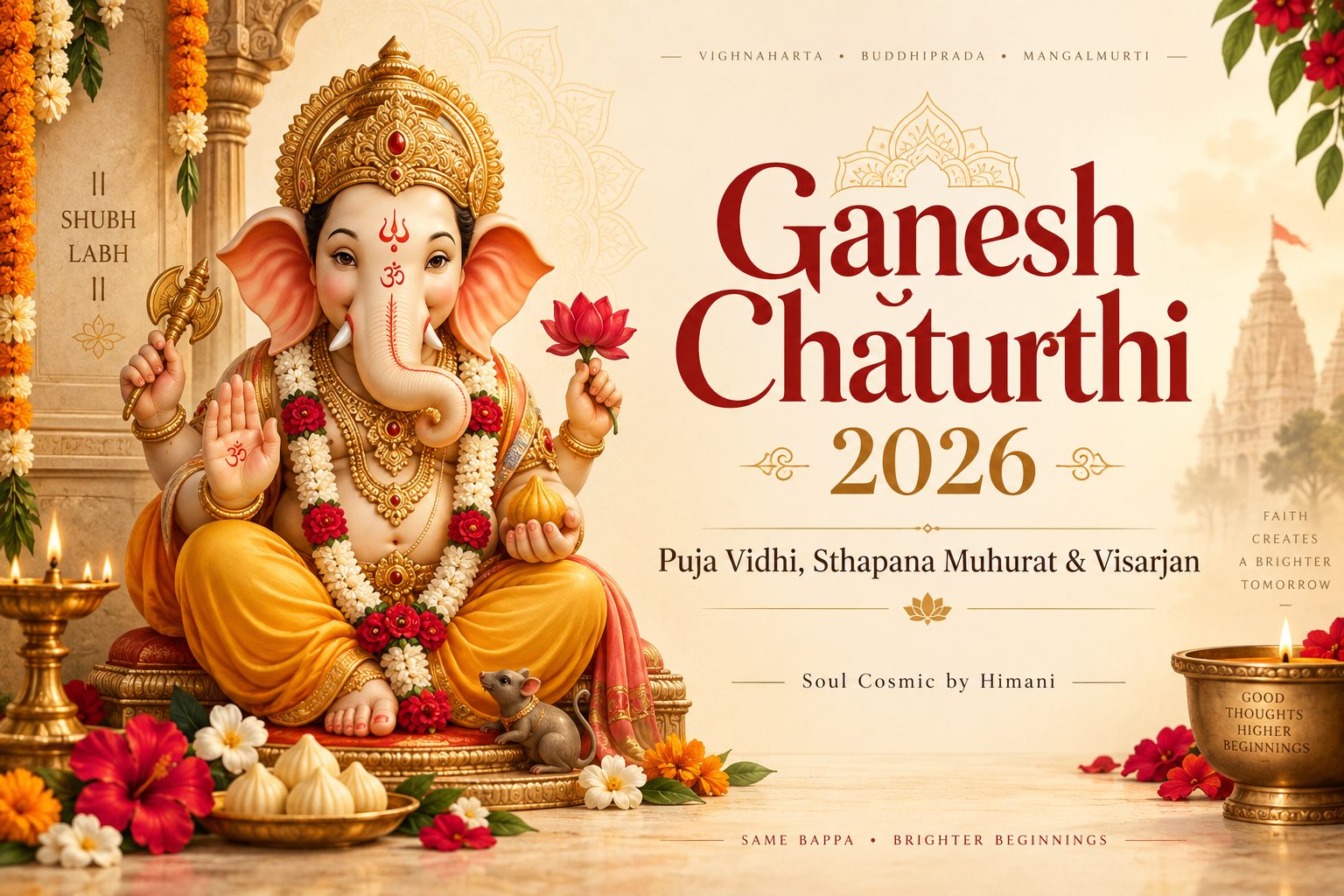
Ganpati Bappa Morya!
Ganesh Chaturthi, also known as Vinayaka Chaturthi, Ganesh Chauth and Ganeshotsav, is one of the most spiritually significant festivals in the Hindu calendar. Dedicated to Lord Ganesha—the deity of wisdom, intelligence, prosperity, auspicious beginnings and removal of obstacles—the festival begins with the ceremonial installation of Ganesha and traditionally concludes with Ganesh Visarjan on Anant Chaturdashi.
In 2026, Ganesh Chaturthi will be celebrated on Monday, 14 September 2026.
According to the Panchang, Bhadrapada Shukla Chaturthi begins in the morning of 14 September and continues until the morning of 15 September. Because Chaturthi prevails during Madhyahna Kaal, the prescribed period for Ganesh Puja, the festival is observed on 14 September.
Ganesh Chaturthi 2026: Date and Muhurat at a Glance
Festival: Ganesh Chaturthi / Vinayaka Chaturthi
Date: Monday, 14 September 2026
Hindu Month: Bhadrapada
Paksha: Shukla Paksha
Chaturthi Tithi begins: 7:06 AM, 14 September 2026
Chaturthi Tithi ends: 7:44 AM, 15 September 2026
Ganesh Sthapana and Madhyahna Puja Muhurat — New Delhi
11:02 AM to 1:31 PM
Duration: approximately 2 hours 28 minutes.
The Madhyahna period is specifically preferred because Hindu tradition associates Lord Ganesha’s manifestation with Madhyahna Kaal. The traditional daytime is divided into Pratah, Sangava, Madhyahna, Aparahna and Sayankal, with Madhyahna being considered the appropriate period for Ganapati Sthapana and the principal Chaturthi Puja.
Major City-Wise Ganesh Sthapana Muhurat
| City | Madhyahna Ganesh Puja Muhurat |
|---|---|
| New Delhi | 11:02 AM – 1:31 PM |
| Bengaluru | 11:02 AM – 1:28 PM |
| Mumbai | 11:20 AM – 1:48 PM |
| Pune | 11:16 AM – 1:44 PM |
| Chennai | 10:51 AM – 1:18 PM |
| Hyderabad | 10:58 AM – 1:25 PM |
| Jaipur | 11:08 AM – 1:36 PM |
| Ahmedabad | 11:21 AM – 1:49 PM |
| Chandigarh | 11:04 AM – 1:33 PM |
| Kolkata | 10:18 AM – 12:46 PM |
| Noida | 11:02 AM – 1:30 PM |
These are local clock timings for the respective cities.
Why Is Lord Ganesha Worshipped First?
Lord Ganesha is called Pratham Pujya—the deity worshipped before other deities and before the beginning of auspicious work.
Whether it is a wedding, housewarming, business inauguration, examination, journey, spiritual ceremony or a new phase of life, Hindu tradition commonly begins with Ganesh Vandana.
This is because Ganesha represents Buddhi—wisdom and right understanding—and Vighnaharta, the remover of obstacles. Traditional descriptions also associate him with Riddhi, Siddhi, Shubh and Labh—prosperity, spiritual accomplishment, auspiciousness and gain.
The Beautiful Story Behind Pratham Pujya Ganesha
One popular traditional story concerns Lord Ganesha and his brother Kartikeya.
A divine challenge was given: whoever could circle the entire world first would emerge victorious.
Kartikeya immediately departed on his swift peacock.
Ganesha looked at his own tiny mouse vehicle and knew that winning through physical speed would be difficult.
Instead, Ganesha calmly walked around his parents, Lord Shiva and Goddess Parvati.
When questioned, Ganesha explained that one’s parents represent the entire universe; therefore, circumambulating them with reverence was equivalent to circumambulating the world.
His answer revealed something deeper than speed: wisdom can accomplish what force alone cannot.
Ganesha was declared victorious, and the tradition of honouring him before auspicious undertakings became deeply associated with his wisdom and status as Pratham Pujya. Different Puranic and regional traditions narrate the details differently, but all preserve the central symbolism of Ganesha’s wisdom and primacy.
That story contains one of Ganesh Chaturthi’s most beautiful lessons:
Do not begin life merely with speed. Begin with wisdom.
The Birth Story of Lord Ganesha
According to a widely followed Puranic tradition, Goddess Parvati created Ganesha and asked him to guard her chamber.
When Lord Shiva arrived, Ganesha—unaware of Shiva’s identity and completely devoted to his mother’s command—refused to allow him inside.
A confrontation followed and Ganesha was beheaded.
Seeing Parvati’s grief, Shiva promised to restore her son. An elephant’s head was placed upon Ganesha, bringing him back to life.
He was accepted as the son of Shiva and Parvati and given a distinguished place among the divine beings.
The elephant head itself later became a profound spiritual symbol: large ears to listen, a large head for wisdom, small eyes for concentration and a trunk representing intelligence capable of handling both the subtle and the enormous.
Why Ganesh Chaturthi 2026 Is Astrologically Special
The 2026 celebration has an interesting Panchang and planetary backdrop.
Ganesh Chaturthi falls on a Monday—Somavara, traditionally governed by the Moon.
On 14 September, Chitra Nakshatra continues until approximately 1:55 PM, after which Swati begins. Brahma Yoga operates until around 12:46 PM, followed by Indra Yoga. Therefore, the important Madhyahna Ganesh Puja window occurs largely within Chitra Nakshatra, with a substantial portion also under Brahma Yoga.
Symbolically this is meaningful.
Chitra Nakshatra — Creating Something Better
Chitra carries themes connected with construction, design, refinement, skill and bringing a vision into visible form.
For spiritual seekers, this Ganesh Chaturthi can therefore become an occasion to ask:
What am I ready to rebuild differently?
Brahma Yoga — Energy of Creation
Brahma Yoga traditionally carries a constructive, knowledge-oriented quality.
Ganapati is himself the lord of intelligence and discrimination. Beginning a spiritual sankalp during such an atmosphere beautifully supports the theme of replacing confusion with conscious creation.
Strong Benefic Planetary Placements
Sidereal planetary calculations for 14 September 2026 place:
- Mercury in Virgo
- Jupiter in Cancer
- Venus in Libra
- Saturn in Pisces
- Rahu in Aquarius
- Ketu in Leo
Mercury in Virgo, Jupiter in Cancer and Venus in Libra are particularly noteworthy from a classical Vedic astrology perspective because these planets occupy signs where their natural significations become strong.
This creates a beautiful symbolic combination for Ganesh worship:
Mercury: intellect, communication and decision-making
Jupiter: wisdom, blessings, knowledge and dharma
Venus: relationships, harmony, creativity and abundance
Therefore, Ganesh Chaturthi 2026 can be approached as a particularly meaningful occasion for sankalps connected with:
career direction, education, business, financial wisdom, communication, healing relationships, creative projects and spiritual clarity.
However, festival astrology is a collective background. Individual results always depend on one’s personal birth chart, dasha and transits.
Ganesh Chaturthi 2026 Puja Samagri
For a simple home puja, devotees may arrange:
- Eco-friendly clay Ganesha idol
- Clean chowki or raised platform
- Red or yellow cloth
- Kalash
- Water
- Kumkum and turmeric
- Akshat or unbroken rice
- Sandalwood paste
- Janeu
- Durva grass
- Red flowers
- Garland
- Incense
- Ghee/oil diya
- Camphor
- Coconut
- Seasonal fruits
- Betel leaves and nuts according to family tradition
- Modak or laddoo
- Panchamrit if used in your tradition
- Dakshina
- Aarti plate
Keep the puja simple if necessary. Bhava—devotion—is more important than extravagance.
Ganesh Chaturthi Puja Vidhi: Step-by-Step Home Ritual
Traditional Ganesh Chaturthi worship may be performed through Shodashopachara Puja—the sixteen forms of offering. Before these sixteen steps, Deep Prajwalan and Sankalpa are generally performed.
1. Purify Yourself and the Puja Space
Bathe in the morning and wear clean clothes.
Clean the puja area and decorate the place where Bappa will be seated.
Place the idol respectfully on a clean raised platform.
An eco-friendly natural clay idol is ideal, especially if visarjan will be performed at home.
2. Light the Diya
Lighting a lamp symbolically invites knowledge and removes darkness.
Sit peacefully for a few moments before beginning.
3. Take Sankalpa
Take water, flowers and rice in your hand and state your intention.
You may pray:
“May Lord Ganesha remove obstacles from my path, grant me wisdom to make correct decisions and bless my family with peace, health, prosperity and spiritual growth.”
4. Ganapati Sthapana
Install the new Ganesha idol during the appropriate Madhyahna muhurat.
Chant:
Om Shri Ganeshaya Namah
or
Om Gam Ganapataye Namah
5. Avahana
Invite Lord Ganesha’s divine presence into the worship.
Detailed pran-pratishtha can be conducted by a qualified priest, but household devotees may perform a simple devotional invocation with sincere prayer.
If you are worshipping a permanently installed Ganesha murti already present in your home temple, Avahana and temporary installation rituals are generally not performed in the same manner as for a festival murti.
6. Offer Asana, Water and Respect
Symbolically offer Ganesha a seat, water for washing the feet, hands and sipping, according to the Shodashopachara tradition.
7. Snana and Vastra
According to your household tradition, symbolically bathe the deity or offer water.
Offer clean cloth or vastra.
8. Apply Gandha and Kumkum
Offer sandalwood paste, kumkum and akshat.
9. Offer Durva
Durva grass is among the most traditional offerings made to Ganesha.
Offer it reverently while remembering the qualities you want to cultivate—calmness, resilience and simplicity.
10. Offer Flowers
Red flowers are commonly offered.
With each flower, mentally surrender one obstacle: anger, fear, confusion, ego, resentment or indecision.
11. Dhoop and Deep
Offer incense and then the lamp.
The fragrance represents purification; the flame represents consciousness.
12. Offer Naivedya
Offer modak, laddoo, fruits, coconut or other sattvic preparations.
Modak is particularly associated with Ganesha and symbolizes the sweetness of spiritual knowledge.
13. Chant Ganesha Mantras
A simple mantra suitable for everyone is:
ॐ गं गणपतये नमः
Om Gam Ganapataye Namah
You may chant it 11, 21, 54 or 108 times according to your capacity.
14. Read Ganesh Katha
Read or listen to the Ganesh Chaturthi story and reflect upon the meaning behind Ganesha’s wisdom.
15. Perform Ganesh Aarti
Perform aarti with devotion.
Offer your final prayers for wisdom rather than merely asking for external results.
16. Pradakshina, Namaskar and Prasad
Offer respectful circumambulation according to your family tradition, bow before Ganesha and distribute prasad.
Traditional Shodashopachara worship forms the ritual framework for Ganesh Chaturthi Puja.
A Simple Spiritual Sankalpa for Ganesh Chaturthi 2026
This year, rather than asking Bappa only to “remove my problems,” make the prayer deeper:
“Bappa, remove what is blocking my wisdom. Give me clarity to recognise the right path, courage to walk it, humility to correct myself and strength to complete what I begin.”
Sometimes Vighnaharta removes the obstacle.
Sometimes he gives us the intelligence to realise that we ourselves were the obstacle.
Why Should We Avoid Looking at the Moon on Ganesh Chaturthi?
One of the most interesting traditions associated with Ganesh Chaturthi concerns Chandra Darshan.
According to Puranic tradition, seeing the Moon during Bhadrapada Shukla Chaturthi is associated with Mithya Dosha or Mithya Kalank—the possibility of false blame or accusation.
Moon-Sighting Avoidance Period for New Delhi — 14 September 2026
9:06 AM to 8:04 PM
The timing changes by location because moonrise and moonset depend upon geographical position.
The Story of Ganesha, Chandra and the Syamantaka Mani
Tradition tells us that Chandra, the Moon deity, once mocked Ganesha’s appearance.
Ganesha cursed Chandra, declaring that whoever looked at the Moon on Bhadrapada Shukla Chaturthi would become vulnerable to false accusation and dishonour.
Later, the curse was moderated, but the Chaturthi restriction remained.
The best-known story associated with this belief involves Lord Krishna.
Krishna accidentally saw the Moon on Bhadrapada Shukla Chaturthi and was subsequently falsely accused in connection with the disappearance of the precious Syamantaka Mani.
Sage Narada explained the connection with the Chaturthi moon tradition. Krishna observed Ganesha worship and ultimately cleared his name.
This is why the belief became associated not with physical danger but particularly with Mithya Kalank—undeserved accusation or reputational blame.
This is a religious and cultural tradition, rather than a scientific claim.
What If You Accidentally See the Moon?
First—do not panic.
Traditional practice itself provides a remedy.
1. Recite the Syamantaka Mantra
सिंहः प्रसेनमवधीत्सिंहो जाम्बवता हतः।
सुकुमारक मा रोदीस्तव ह्येष स्यमन्तकः॥
Simhah Prasenamavadhit Simho Jambavata Hatah,
Sukumaraka Ma Rodis Tava Hyesha Syamantakah.
This is the traditional Mithya Dosha prevention verse given in connection with the Syamantaka story.
2. Read or Listen to the Syamantaka Mani Katha
Hearing or remembering Krishna’s Syamantaka story is also traditionally practised as a parihara.
3. Pray to Lord Ganesha
Chant:
Om Gam Ganapataye Namah
and offer Durva, flowers or a simple heartfelt prayer.
The spiritual lesson is more important than fear: do not allow superstition to produce anxiety. Traditional remedies exist precisely to restore one’s mental and devotional balance.
How Long Should You Keep Ganpati at Home?
There is no rule that every household must keep Ganpati for the full festival.
Families traditionally choose the duration according to their family custom and sankalpa.
Common observances in 2026 include:
1½-day Visarjan: 15 September
3-day Visarjan: 16 September
5-day Visarjan: 18 September
7-day Visarjan: 20 September
Anant Chaturdashi Visarjan: 25 September 2026
The main public Ganeshotsav culminates on Anant Chaturdashi.
Whichever duration you choose, honour the sankalpa with consistency rather than feeling that a longer stay is automatically spiritually superior.
Ganesh Visarjan 2026
The principal Ganesh Visarjan takes place on:
Friday, 25 September 2026
This is Anant Chaturdashi, the final major day of Ganeshotsav. Drik Panchang also identifies 25 September as the principal Ganesh Visarjan day.
Before Visarjan:
- Perform the final puja.
- Offer flowers, Durva and naivedya.
- Perform aarti.
- Thank Bappa for staying in your home.
- Ask forgiveness for any ritual mistakes.
- Gently move the murti from its place.
- Perform visarjan according to your family tradition.
The emotional cry:
“Ganpati Bappa Morya, Pudhchya Varshi Lavkar Ya!”
expresses neither a permanent goodbye nor loss.
It means: Come back soon.
Visarjan carries one of Hindu spirituality’s most profound teachings: forms arrive, stay for a while and eventually dissolve, but the divine principle behind the form remains eternal.
Anant Chaturdashi 2026
Anant Chaturdashi is not only Ganesh Visarjan day.
It is also an important independent vrata dedicated to Lord Vishnu in his Ananta form—the Infinite One.
In 2026:
Anant Chaturdashi: Friday, 25 September 2026
For New Delhi, Shukla Chaturdashi begins at approximately 11:18 PM on 24 September and continues until about 11:07 PM on 25 September.
The Anant Chaturdashi worship tradition includes an Anant Sutra, commonly prepared with fourteen knots.
The fourteen knots are traditionally associated with the fourteen lokas or realms, while “Ananta” represents that which has no end.
Therefore the final day beautifully combines two teachings:
Ganesha Visarjan teaches impermanence.
Ananta reminds us of the Eternal.
The form dissolves.
The Divine does not.
Ganesh Chaturthi 2026: The Deeper Astrological Message
Ganesh Chaturthi should never become only a festival of decoration.
Ganesha’s symbolism asks us to work upon our own inner architecture.
His large head says: think beyond the immediate problem.
His large ears say: listen before reacting.
His small eyes say: concentrate.
His broken tusk says: sacrifice perfection when a greater purpose requires it.
His large belly says: learn to digest life’s pleasant and unpleasant experiences.
His mouse vehicle represents desire—the restless tendency constantly running from one object to another.
When Ganesha rides the mouse, the message is simple:
Wisdom must ride desire. Desire should not ride wisdom.
And perhaps that is the most powerful remedy we can practise this Ganesh Chaturthi.
Astrologer’s Special Remedy for Ganesh Chaturthi 2026
Because the 2026 planetary background strongly highlights Mercury, Jupiter and Venus themes, use the festival to work consciously in three areas.
For Career, Business and Decision-Making
Chant:
Om Gam Ganapataye Namah
21 or 108 times.
Write down one decision you have been postponing and ask for clarity—not simply favourable circumstances.
For Education and Knowledge
Offer Durva and pray for Buddhi, concentration and right understanding.
Students may keep their books near the puja area respectfully and seek Ganesha’s blessings.
For Relationships
Instead of praying merely for another person’s behaviour to change, ask:
“May I communicate with wisdom, understand without ego and recognise relationships that support my dharma.”
For Financial Growth
Offer a simple modak or laddoo and make a practical prosperity sankalpa.
Remember that Ganesha’s prosperity symbolism is linked to Buddhi before Labh—wisdom before gain.
That itself is an excellent financial remedy.
Eco-Friendly Ganesh Chaturthi
Spirituality and environmental responsibility should support each other.
Whenever possible:
- Choose a natural clay murti.
- Avoid toxic paints and chemical decorations.
- Minimise plastic.
- Use flowers, leaves, cloth and reusable decoration.
- Perform home immersion in a suitable container when practical.
- Allow the clay to dissolve naturally.
- Use the resulting soil respectfully for plants where appropriate and permitted.
The God of wisdom should never be celebrated in a way that harms the very environment sustaining us.
Final Message for Ganesh Chaturthi 2026
Ganesh Chaturthi is not merely about asking Lord Ganesha to make every road easy.
Sometimes a blocked road protects us.
Sometimes a delay teaches patience.
Sometimes a rejection redirects destiny.
And sometimes what we call an “obstacle” is actually Ganesha asking us to rethink our approach.
This Ganesh Chaturthi, pray not only:
“Bappa, remove my obstacles.”
Also pray:
“Bappa, give me the wisdom to understand which obstacles must be removed, which must be crossed, and which are redirecting me towards something better.”
May Lord Ganesha bless your home with Buddhi, Siddhi, Riddhi, Shubh and Labh.
May confused thoughts become clear.
May delayed paths begin moving.
May relationships become wiser.
May prosperity come with stability.
And above everything else, may you have the intelligence to recognise the blessings already entering your life.
Ganpati Bappa Morya!
Mangal Murti Morya!
Love and Light,
Himani Goyal

Leave a Reply