
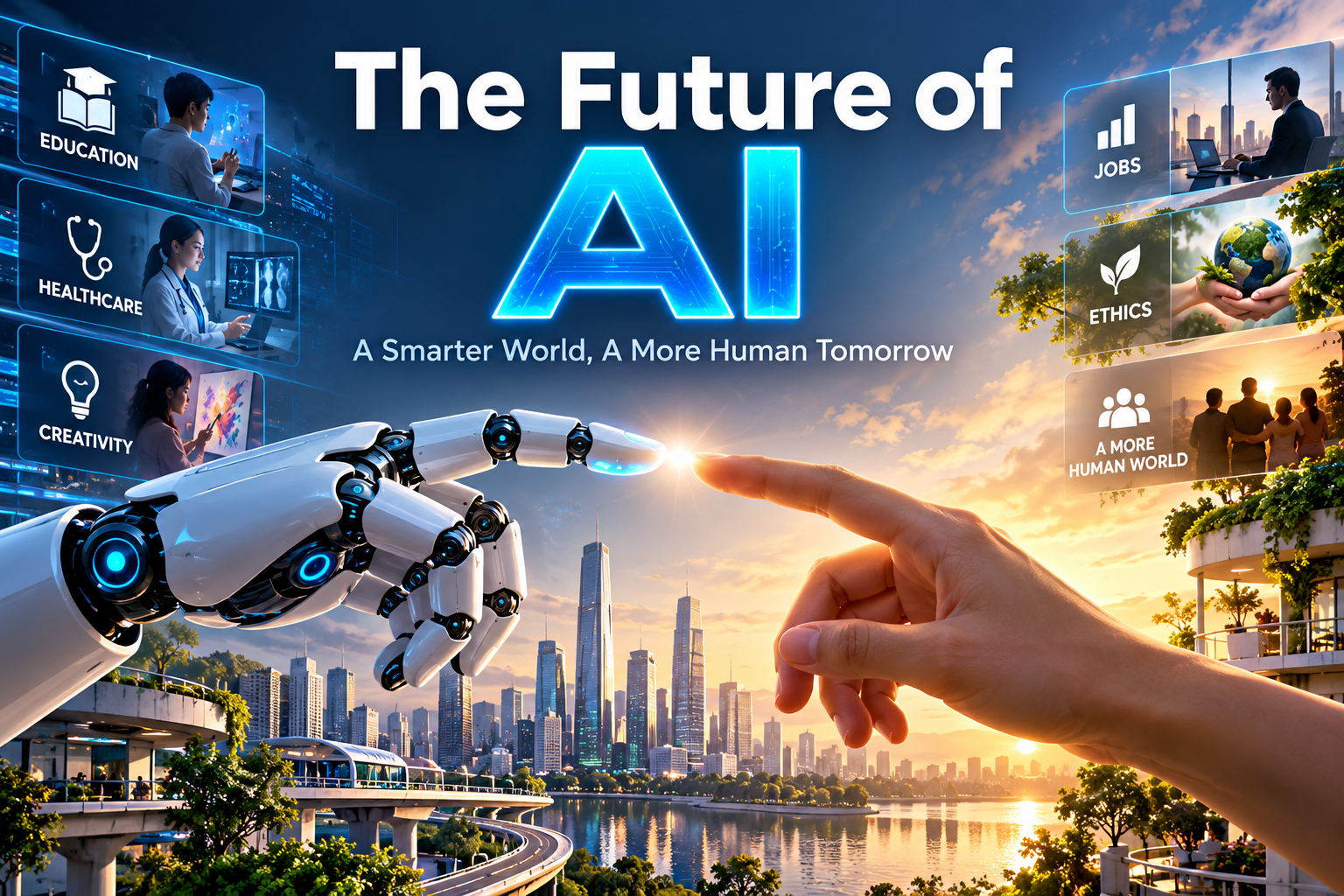
What do you think is the future of AI?
The Future of AI: Will Machines Make Us Smarter or Simply More Human?
Artificial Intelligence is no longer a futuristic idea hiding inside science-fiction movies.
It is already writing, designing, analysing, translating, teaching, recommending, diagnosing patterns, helping businesses make decisions, and quietly becoming part of our everyday lives.
So the real question is no longer:
“Will AI change the world?”
It already has.
The more interesting question is:
“What kind of world will we create with AI?”
AI Will Become Less Visible, but More Powerful
Today, we consciously open an AI tool and type a question.
In the future, AI may become almost invisible.
It could work quietly inside our phones, cars, homes, offices, hospitals, classrooms and businesses. Instead of asking AI for help, we may simply experience technology that understands what we need before we even realise we need it.
Imagine your digital assistant organising your day, summarising information, preparing reports, reminding you of priorities and helping you make faster decisions.
AI may stop feeling like a separate technology.
It may simply become part of life.
Jobs Will Change, Not Simply Disappear
One of the biggest fears around AI is employment.
“Will AI take our jobs?”
Some jobs will certainly change. Repetitive and predictable tasks are especially likely to become automated.
But history tells us something interesting.
Technology usually removes certain tasks while creating completely new industries, professions and opportunities.
The real competition may not be:
Human vs AI.
It may become:
Human using AI vs Human ignoring AI.
People who learn how to work with technology will probably have a major advantage.
Creativity, emotional intelligence, communication, leadership, judgement, empathy and relationship-building may become even more valuable.
Because machines can process information.
But human connection still has a different heartbeat.
AI Could Transform Education
Imagine every student having a personal tutor available anytime.
A child struggling with mathematics could receive explanations according to their learning style. Someone learning a language could practise conversations instantly. Professionals could continuously upgrade their skills without waiting for traditional classrooms.
Education could become more personalised.
Instead of asking everyone to learn in exactly the same way, AI could help people learn at their own pace.
However, this creates another challenge.
Students must learn not only how to get answers, but also how to think.
Critical thinking may become one of the most important skills of the AI generation.
Healthcare Could Become More Predictive
AI may also play a huge role in healthcare.
Instead of waiting for illness to become serious, technology could help identify patterns much earlier.
Doctors may use AI to analyse scans, medical histories and large amounts of research more quickly.
But AI should support healthcare professionals, not replace human compassion.
Because when someone is scared, vulnerable or unwell, they do not only need information.
They need reassurance.
They need empathy.
They need another human being.
Creativity Is Entering a New Era
Writers, designers, musicians, filmmakers and content creators are already experimenting with AI.
Does this mean creativity will disappear?
I don’t think so.
AI can generate ideas, visuals, music and words, but creativity is not simply production.
Creativity comes from experience.
A heartbreak.
A childhood memory.
A dream.
A struggle.
A belief.
A strange idea that arrives at 2:00 AM.
AI can help us create faster, but humans still give creativity its meaning.
Perhaps the future artist will not fight technology.
They will learn how to dance with it. 🎨🤖
The Biggest Question Is Ethical
AI becoming powerful is not necessarily frightening.
AI becoming powerful without responsibility is.
Who controls the technology?
Who protects personal information?
How do we prevent misinformation?
How do we identify AI-generated content?
How do we make sure technology benefits society rather than only a small number of organisations?
These questions may become as important as the technology itself.
Because every powerful invention carries two possibilities:
Progress and misuse.
The difference is usually human intention.
Will AI Ever Become Like Humans?
AI may eventually become extraordinarily capable.
It may reason better, communicate more naturally and perform tasks that currently require highly trained professionals.
But intelligence and humanity are not necessarily the same thing.
A machine may understand millions of books.
But does it understand the feeling of waiting for someone you love?
It may analyse thousands of poems.
But does it experience longing?
It may identify sadness in someone’s words.
But does it actually feel sadness?
Perhaps the future of AI will force us to ask an unexpected question:
What exactly makes a human being human?
And ironically, technology may help us appreciate the answer.
My View of the Future
I don’t see the future of AI as humans versus machines.
I see it as a partnership.
AI could become one of the most powerful tools humanity has ever created.
It could help us work faster, learn quicker, discover more and solve problems that once seemed impossible.
But technology should amplify human intelligence, not replace human wisdom.
The future will belong to people who know when to use technology and when to put the screen down.
Who know how to ask better questions.
Who remain curious.
Who keep learning.
And most importantly, who remain deeply human in an increasingly intelligent world.
Thought of the Day
The future of AI will not be decided only by how intelligent machines become. It will be decided by how wisely humans choose to use them.
And perhaps that is the most exciting part.
The future is not being written by AI alone.
We are writing it together.

Leave a Reply