
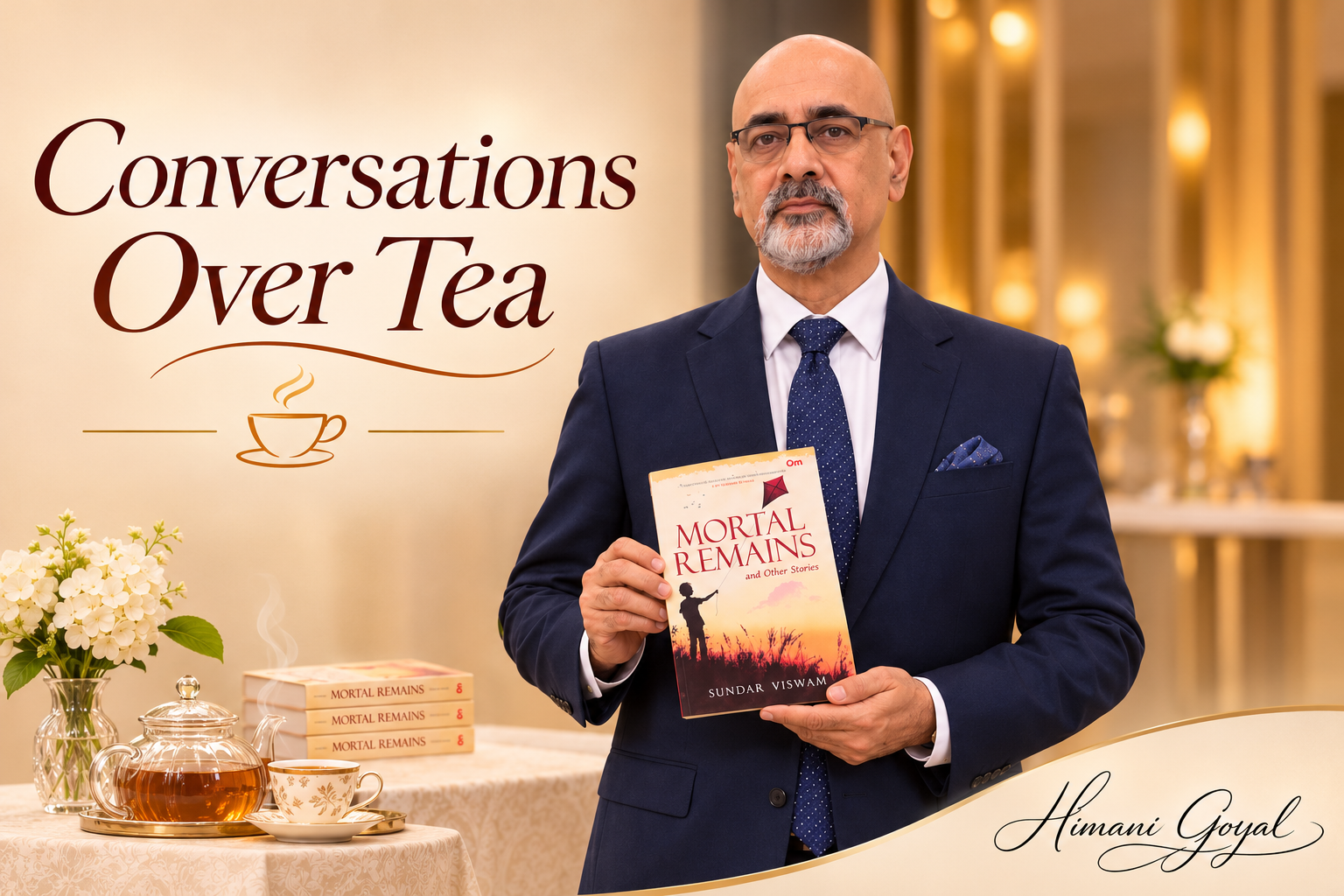

Stories • People • Choices • Conversations
Hosted by Himani Goyal | Himani Goyal Soul Studio
Welcome to Conversations Over Tea ☕
Every book has a story, but behind every story lies a fascinating world of emotions, experiences and untold truths.
Welcome to Conversations Over Tea, an engaging literary series by Himani Goyal Soul Studio, where we explore the minds of authors, discover the inspirations behind their writing and enjoy meaningful conversations over a warm cup of tea.
In this edition, we are delighted to feature Sundar Viswam, author of Mortal Remains and Other Stories.
His collection explores the complexities of human relationships, friendship, love, betrayal, morality, migration, destiny and the choices that shape our lives.
Through 11 thought-provoking short stories, Sundar invites readers to look beyond ordinary situations and discover the extraordinary emotions hidden within them.
In this heartfelt conversation, he shares his creative journey, his perspectives on human behaviour, his emotional connection with his characters and some delightful behind-the-scenes revelations.
So, grab your favourite cup of tea and join us for a conversation filled with stories, reflections, laughter and literary wisdom!
The Conversation: Stories Behind the Stories
1. The Meaning Behind Mortal Remains
Himani Goyal: Sundar, welcome to Conversations Over Tea. Why the title Mortal Remains? What, in your view, remains after a powerful human experience: memory, regret, love, creativity or something else?
Sundar Viswam:
First, thank you for taking the time to interview me. I greatly appreciate it.
Actually, your second question answers the first!
Just as the soul remains after our passing, so too do memories remain after any great experience in life. They are the “mortal remains” of our life experiences.
These memories can bring joy, sorrow, love, regret or even hate.
This collection, while not autobiographical, reflects what has remained from those experiences. Hence, the title Mortal Remains.
2. The Art of Observing Human Nature
Himani Goyal: Your stories begin with ordinary situations but often uncover something much deeper about human nature. Are you naturally an observer of people, or did writing train you to notice these details?
Sundar Viswam:
No, I am not a deliberate observer of people, and I do not set out to make mental notes about things that happen. I am too absent-minded for that!
But, to be honest, like most introverts, I probably tend to unconsciously listen and observe more than I speak.
Maybe some of that remains in my subconscious and reappears when I write, even without my consciously relating it to the original events.
3. The Witty Observer or the Sensitive Storyteller?
Himani Goyal: You are known for wit and social commentary as well as emotional storytelling. Which Sundar is closer to the person behind the page: the witty observer or the sensitive storyteller?
Sundar Viswam:
I am equally both!
The only difference is that the funny side of me takes a long time to appear when I am in company.
In the presence of my family and close friends, I can be a complete buffoon at times. But in the company of others, I can come across as serious and reserved.
Many a time, what starts out as a funny story becomes a tragedy, and vice versa. A sad story can become witty.
But I think I tend to err on the side of seriousness most of the time.
4. How Much of the Writer Lives Within the Characters?
Himani Goyal: The title story explores creativity, loneliness and a writer’s relationship with his art. How much of a writer inevitably enters a fictional character, even when the character is not autobiographical?
Sundar Viswam:
That is really an interesting question!
I often think it is not possible to write stories, whatever their length or genre, without injecting some part of yourself into them.
Even non-fiction will have some aspect of your experience creeping into it quite unconsciously.
After all, writing is putting down your thoughts, and that always has something of you in it.
I think that is the difference between human writing and AI writing!
5. Childhood Memories and The Red Kite
Himani Goyal: The Red Kite takes us into childhood friendship and rivalry. Do you think childhood experiences stay inside us much longer than adults usually acknowledge?
Sundar Viswam:
Oh yes, absolutely!
I have a theory about the human brain. It is simply a recorder with infinite memory and disk space!
It’s all there, always. You just need to press the right button to bring something to the fore.
The problem is that the buttons are not entirely under your control!
6. Affection, Self-Interest and Human Contradictions
Himani Goyal: In Manda oh my Manda!, affection and self-interest seem capable of existing together. Do you deliberately enjoy placing readers in situations where right and wrong are not easily separated?
Sundar Viswam:
No, no, not at all!
I must say that I am not what they call a “method” writer.
I rarely have more than a tiny germ of an idea. I don’t write out the plots, characters or events.
I just sit in front of the computer with that germ of an idea, and it grows and takes shape as I write!
Sometimes it turns out to be sad, and sometimes it becomes funny, but it always happens quite naturally.
In a way, all my stories are streams of consciousness!
7. Family Relationships and The Invitation
Himani Goyal: The Invitation uses an everyday social occasion to reveal family tensions. Why do weddings, celebrations and rituals so often bring hidden equations to the surface?
Sundar Viswam:
I think that while humans are social animals by nature, it requires a lot of work to keep interactions socially acceptable.
Some of this work involves diplomacy, tact and often hypocrisy.
Marriages and other rituals can be intense and emotional.
Many times, we let the veneer drop away in the heat of the moment, and things become messy!
8. Can Friendship Survive Complete Honesty?
Himani Goyal: Falling Out raises questions about friendship, perception and concealed feelings. Can every friendship survive complete honesty, or do some relationships survive because certain things remain unsaid?
Sundar Viswam:
Like I said, we leave a lot of things unsaid in our daily interactions, out of diplomacy, civility or simply because we don’t care enough.
But these are not real friendships. They are just associations.
A true friendship demands complete honesty, and that presupposes a sense of care.
When you suppress too many feelings in a relationship, they find a weak spot, like lava from a volcano, and erupt, just as they do in Falling Out.
9. The Grey Areas of Human Behaviour
Himani Goyal: Many of your characters are neither heroes nor villains. Was this moral grey zone intentional? Do you feel most people are capable of both generous and questionable choices depending on their circumstances?
Sundar Viswam:
Yes, I think we are all amalgamations of good and bad, perhaps in different proportions.
I generally tend to put myself in someone else’s shoes and think about what could have prompted certain things to happen.
Oftentimes, I end up thinking I would have done exactly the same thing in that position!
I forgive easily, and I think that seeps into my characters too!
10. Destiny, Chance and the Unpredictability of Life
Himani Goyal: The God of Chance plays with coincidence and circumstance. Personally, do you believe in destiny and chance, or do human beings create meaning around random events after they happen?
Sundar Viswam:
My view of destiny changes with every event!
If things go according to my plan, I forget destiny and pat myself on the back.
But let things go wrong, and my finger always points to destiny!
Sometimes, however, things happen, like they did in The God of Chance, for which there is no logical explanation or rationale.
At that time, it is just easier to put it down to “sab kismat ka khel hai!”
11. Life Abroad, Identity and Belonging
Himani Goyal: Regrettably, Yours touches on professional success alongside the uncertainty of immigrant life. Has living across cultures influenced the way you understand identity and belonging?
Sundar Viswam:
Yes, living in a foreign country often shines a spotlight on many previously unconsidered aspects of life and people’s character traits.
You are, in a sense, outside looking in and inside looking out.
Practically speaking, people give up a lot to go abroad, and it is not easy to return.
At such times, you begin to compromise.
Regrettably, Yours is the story of compromise becoming extreme.
12. Principles, Integrity and Ego
Himani Goyal: In A Matter of Principle, conviction and consequence collide. At what point can standing by one’s principles stop being integrity and start becoming ego?
Sundar Viswam:
The problem is not caused by standing by your principles.
It becomes an issue when you expect others to sacrifice their principles for yours, when you think your principles are more important than theirs simply because they are yours.
In A Matter of Principle, everybody’s principles collide at one point, like a pile-up on a highway!
13. Honesty, Temptation and Everyday Corruption
Himani Goyal: Just Token explores honesty and everyday corruption. Do people discover their real values only when those values begin to cost them something?
Sundar Viswam:
Yes, I think for most people, honesty is like a cloak they wear, and depending on convenience, the colour of the cloak changes.
To use an oft-repeated cliché, everybody has their price, and people don’t mind dipping into corruption when nobody is looking!
14. Rumours and Hidden Social Prejudices
Himani Goyal: Pleasanton uses a rumour to expose assumptions, aspirations and prejudice. Why are rumours so effective at revealing what people may secretly think?
Sundar Viswam:
Rumours are a reflection of the society we live in.
By spreading a rumour, we enjoy the convenience of anonymity and don’t have to take ownership of the opinion.
We can literally fire a rifle from somebody else’s shoulder.
Pleasanton reveals so many hidden aspects of immigrant life because so many people get to say what they really want to say through somebody else!
15. What Characters Say and What They Leave Unsaid
Himani Goyal: Your characters often reveal themselves through hesitation, dialogue and silence. As a writer, what fascinates you more: what people say or what they carefully avoid saying?
Sundar Viswam:
Like I said, I don’t plan what my characters will do.
I let things happen, and similarly, I let the characters react and respond to those events.
That is why my characters are a mixture of so many human traits.
And since they are unplanned, they are unpredictable too.
16. The Emotional Journey of Writing
Himani Goyal: The collection touches on love, betrayal, friendship, prejudice, migration, compromise and fate. Which theme became unexpectedly personal or emotionally demanding while you were writing?
Sundar Viswam:
Every time I read my stories, I automatically become a first-time reader again.
All these stories are written straight from the heart, raw and unfiltered, and my emotions respond the same way.
They exhaust me and drain me emotionally, whether I am writing or reading them.
I just let it rip, straight from the heart!
I don’t think I will write any other way.
17. How Real-Life Experiences Become Fiction
Himani Goyal: Did any story begin with something you actually saw, overheard or experienced, and then evolve into something completely different on the page?
Sundar Viswam:
I often compare writers to Newton and the falling apple.
He built the whole theory of gravity around that apple.
We writers take a germ, a tiny seed of some experience, event or words, and build a whole orchard, that is, a story, around it!
We probably cannot pinpoint a particular experience relating to a story, but it is all there in the constantly heaving ocean we call the brain!
18. The Most Emotionally Challenging Story
Himani Goyal: Which story was emotionally the hardest to write, and which was the most enjoyable?
Sundar Viswam:
The Invitation was my first proper short story.
I wrote it more than 30 years ago, and it took a lot out of me because that was when I discovered an intensity within me that I did not know existed.
I don’t really “enjoy” any of my stories in the conventional sense.
While they are all intensely emotional and wipe me out, they are also refreshing and, in a way, reassuring because they remind me that I can still feel so much.
They say a forest fire burns everything to the ground, but that is nature’s way of making room for new plants to grow.
That is what each one of my stories does to me.
19. Tea with a Fictional Character
Himani Goyal: If you could sit down for tea with one character from your own book, whom would you invite, and what would you ask them?
Sundar Viswam:
I think I would like to invite Nate Subbu from Regrettably, Yours for a chat.
That character is so unlike many of my other characters.
He is entirely focused on just one goal and almost seems like an automaton as he moves towards it.
Well, the only question I would ask him would be:
“Nate, was there no other way?!”
20. Behind-the-Story Gossip: A Different Ending
Himani Goyal: Authors usually know things about their characters that never reach the final manuscript. Can you share one harmless piece of behind-the-story gossip about a character that readers do not know?
Sundar Viswam:
I don’t have any such character.
But in the original story, the ending of The Red Kite was different.
I always had the nagging feeling that it was abrupt, incomplete and illogical.
I sat in front of my laptop and stared at it many times over many years.
Then, one day, it came to me suddenly in a flash, and I added a couple of pages.
I could breathe freely only after that!
21. When Characters Take Over the Story
Himani Goyal: Was there any minor character who unexpectedly grew in importance and almost took over the story?
Sundar Viswam:
Actually, all of them!
Like I mentioned, they are all seeds that eventually grow into an orchard!
22. A Character You Would Never Want as Your Neighbour
Himani Goyal: Which character from the collection would you absolutely not want as your neighbour?
Sundar Viswam:
Without a doubt, Nate Subbu!
But then, how else would I know him so well?!
I need him to live, not as my neighbour, but in my house!
23. What Should Readers Take Away from Mortal Remains?
Himani Goyal: When readers finish Mortal Remains and Other Stories, what feeling, question or thought would you most like to remain with them?
Sundar Viswam:
I would want them to experience every story as if they were part of it.
In fact, that is the reaction I have received from most readers.
But the question they need to ask themselves is:
“Is this what I would have done?”
☕ Tea Break: Quick-Fire with Sundar Viswam
After a heartfelt discussion about literature, emotions and the complexities of life, it’s time to lighten the mood!
Let’s discover the fun, spontaneous and candid side of Sundar Viswam through our special Tea Break Quick-Fire round.
1. Tea or Coffee?
Himani Goyal: Tea or coffee?
Sundar Viswam:
I am now a coffee drinker, but I was a tea drinker for a large part of my life, before which I was a coffee drinker!
2. When Does Creativity Strike?
Himani Goyal: Writing late at night or early in the morning?
Sundar Viswam:
I am a night owl for most things.
3. The Writing Process
Himani Goyal: Plot first or character first?
Sundar Viswam:
Neither. Just write!
Let it go where it takes you!
4. What Makes a Great Story?
Himani Goyal: A brilliant opening or an unforgettable ending?
Sundar Viswam:
Both, preferably!
The first makes sure the reader turns to the next page, and the second keeps them hooked even after the story ends!
5. A Writer’s Biggest Fear
Himani Goyal: Writer’s block or bad reviews: which is scarier?
Sundar Viswam:
Currently, the BIG BAD BLOCK!
I haven’t received too many bad reviews as yet, but I know I will.
The unfair ones will hurt, but I am prepared for them!
6. A Trustworthy Fictional Friend
Himani Goyal: One character you would trust with a secret?
Sundar Viswam:
Raj from Pleasanton.
He seems to keep a secret really well!
7. A Little Literary Gossip!
Himani Goyal: One character whose WhatsApp messages you would secretly love to read?
Sundar Viswam:
Manish from Brother in Need!
8. A Book You Wish You Had Written
Himani Goyal: A book you wish you had written?
Sundar Viswam:
Almost every one I have read!
Major impostor syndrome when I read other people’s books!
9. Sundar Viswam in One Word
Himani Goyal: One word readers would use to describe Sundar Viswam?
Sundar Viswam:
Heartfelt!
10. What’s Coming Next?
Himani Goyal: What are you writing next?
Sundar Viswam:
Some more short stories and a full-length novel, if I can.
☕ The Signature Question: The Story Behind the Story
Every author has a story to tell, but sometimes the most fascinating stories are the ones that remain untold.
At Conversations Over Tea, we have one special question for every author.
Himani Goyal: Every book has a story, but every author also has a story behind the story. What is one thing about this book that readers would never know unless I asked you over tea?
Sundar Viswam:
How long it took me to write these stories. Some of them took years!
A Heartfelt Thank You to Sundar Viswam
Himani Goyal:
Thank you, Sundar, for sharing your thoughts, emotions and experiences with us. Your reflections have offered a wonderful glimpse into the mind of a storyteller and the fascinating world behind Mortal Remains and Other Stories.
Sundar Viswam:
Thank you, Himani!
Your questions were incisive and maybe necessary too. They made me think!
I’ve written many stories but have never spoken or written much about them.
Thank you for giving me an opportunity to do that!
Final Reflections
As our conversation with Sundar Viswam comes to a close, one thought stays with us: stories are not simply about the characters we read; they are also about the emotions, choices and contradictions we recognise within ourselves.
From childhood memories and family relationships to the complexities of human behaviour, destiny and personal principles, Mortal Remains and Other Stories invites readers to reflect on the many shades of life.
And perhaps that is the beauty of storytelling. A fictional character’s journey may quietly encourage us to examine our own.
A heartfelt thank you to Sundar Viswam for sharing his creative experiences, thoughtful observations and delightful sense of humour.
A Question for Our Readers
Have you ever read a fictional character’s story and wondered, “What would I have done in their place?”
We would love to hear your thoughts in the comments.
Until our next conversation, keep reading, keep reflecting and never underestimate the magic of a good story shared over a cup of tea.
Love and Light,
Himani Goyal
Himani Goyal Soul Studio
Conversations Over Tea
Where Stories Meet Conversations ☕📚
Amazon Link: https://amzn.in/d/085ATVfD


Leave a Reply