
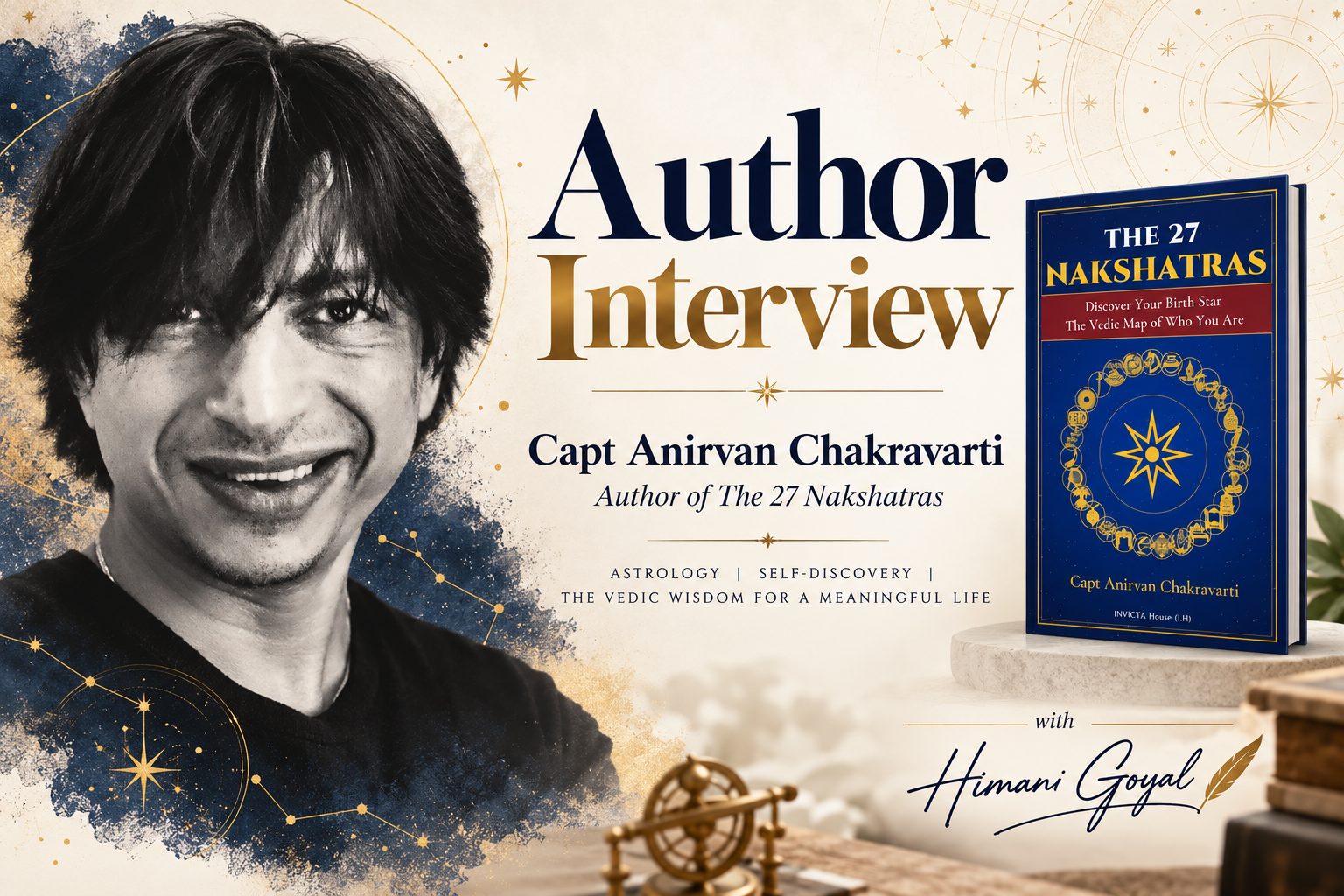

Soul Studio is pleased to present a thoughtful conversation with Captain Anirvan Chakravarti, author of The 27 Nakshatras. The discussion is designed to explore the research behind the book, the classical foundations of Nakshatra study, and the way traditional principles can be tested and understood through real charts.
Captain Chakravarti has described the book as the result of more than ten years of research into Vedic astrology, with particular emphasis on returning to classical sources for each Nakshatra’s deity, symbol, ruling planet and four padas, and then examining what holds up in practice. Alongside the book, he has also created a free birth-star calculator to help readers identify their own Nakshatra.
I. Journey, Research & Inspiration
| A 1 | Captain Chakravarti, your professional life has literally been connected with the skies through aviation, while your personal research has taken you into the celestial world of Vedic astrology. How did the journey from aviation to an intensive study of Jyotish begin for you?
Astrology was in the house before I was. I come from a Bengali orthodox Brahmin family where Jyotish was simply part of life. My grandparents knew astrology, and my father dabbled in it. So it trickled down to me long before I took it seriously. What made me take it seriously was a question. Over the years I kept seeing that two people could make the same decision, with the same effort, and get very different results. Timing seemed to matter as much as the choice itself. Jyotish was the only system I knew that treated timing as something you could study. Flying did the rest. A good part of my flying has been at night, with the stars outside the cockpit window. And flying gives you a habit you never lose: you never trust a single instrument. You cross-check, and you ask where a reading came from before you act on it. When I went back to the classical texts, I went with that habit. |
| A 2 | You have spent more than a decade researching Vedic astrology. What was it about the Nakshatras specifically that fascinated you enough to dedicate an entire book to the subject?
Two things. The first is precision. A zodiac sign covers 30 degrees of sky. A nakshatra covers 13 degrees 20 minutes, and each pada only 3 degrees 20 minutes. That is where Jyotish stops being general and starts being exact. The second is that I understand the nakshatras in three layers. The first layer is the nakshatras themselves, right up in the sky, the fixed backdrop. The second layer is the planets, moving through them. The third layer is what happens when the two meet: how the energy of a nakshatra colours the planet sitting in it, and how that combined energy shows up in a human being. You cannot read the third layer without the first. And I wrote the book because of a gap. The books I found were either friendly but unsourced, or scholarly but closed to beginners. I wanted one book that a curious beginner could open at their own birth star, and that a serious student could use as a full course. |
| A3 | You mention that The 27 Nakshatras goes back to classical sources rather than relying simply on modern interpretations. Which classical texts or traditions influenced your research most, and how did you approach situations where different sources appeared to offer different interpretations?
The classical spine of the book is Brihat Parashara Hora Shastra. Alongside it I worked from the Jaimini Sutras, Varahamihira’s Brihat Samhita, Jataka Parijata, Phala Deepika and Muhurta Chintamani. Among modern writers, the works of Sanjay Rath, K.N. Rao, Ernst Wilhelm, Bepin Behari, David Frawley, Dennis Harness and Hart deFouw were all part of the reading. The classical texts do not always agree. On things like a nakshatra’s caste, its sacred animal, its direction or its colour, different authorities give different answers. My rule was simple. The book follows the Parashari tradition as its spine. Where a disagreement actually changes how you read a chart, both views are given, and the reader is told who holds which. Where it is only a difference of label, I pick one and move on. And wherever an idea is a modern interpretation rather than a classical statement, the book says so. The reader should always know which is which. |
II. Testing Tradition Against Real Charts
| A4 | An important part of your work has been testing classical principles against real birth charts. As a researcher, how do you distinguish a genuinely recurring astrological pattern from coincidence or confirmation bias?
It is the most important question in astrology research, and the honest answer is that it takes discipline. First, I write the rule down before I look at the charts, including what result would prove it wrong. If you look first and decide later, you will always find what you were looking for. Second, I count the misses as well as the hits. A pattern that shows up in seven charts out of ten is interesting only if you also know what happened in the other three. Third, I ask where the birth time came from. A wrong birth time makes any pattern meaningless, and many Indian birth times, especially from hospitals outside the big cities, are rounded to the nearest quarter or half hour. A rounded time can move the Moon into a different pada. And finally, honesty. A great deal of astrology has not been tested properly. A researcher should say that plainly, and not dress belief up as proof. |
| A5 | During those years of chart research, was there any traditional statement about a Nakshatra that initially seemed improbable to you but repeatedly proved meaningful in actual charts?
My biggest surprise was not about any one nakshatra. It was about the padas. Early on, I treated the pada as a fine detail. Charts taught me otherwise. Take Saturn in Ashlesha. The sign is Cancer, ruled by the Moon. The nakshatra is Ashlesha, ruled by Mercury. And then the pada adds a third ruler. In pada 1, from 16°40′ to 20°00′ of Cancer, Saturn falls in the Sagittarius navamsa, so Jupiter’s wisdom softens it. You see the serious scholar, the researcher of hidden things. Move just over three degrees, into pada 2, and Saturn falls in the Capricorn navamsa, its own sign. Now it is undiluted: the long-game strategist, heavier and far more formidable. Same planet, same nakshatra, and two very different Saturns. Once I saw that repeat in real charts, I stopped treating the pada as an afterthought. It is the filter through which everything in the nakshatra comes out. |
III. Understanding the 27 Nakshatras
| A6 | Many people know their Sun sign or Moon sign but have little understanding of their Janma Nakshatra. What can someone’s birth Nakshatra reveal that a zodiac sign alone may not tell them?
A sign tells you how a person appears. The nakshatra tells you what drives them underneath. Two people can have the Moon in the same sign and live completely different inner lives, because the sign is shared by two or three nakshatras, and each has its own nature. The nakshatra carries a deity and a story, and that story gives you the motive. Moon in Bharani, under Yama, carries the courage to face what others run from. Moon in Rohini, the Moon’s own beloved star, carries a deep need for beauty, comfort and belonging. Both could be called “Aries” or “Taurus” people, and you would learn very little. When people read their own nakshatra for the first time, they often say it feels less like a description and more like being recognised. That is the difference. The sign is the outside. The nakshatra is the inside. |
| A7 | Every Nakshatra carries a deity, symbol and planetary ruler. Should these be interpreted separately, or do they form one integrated story? How can an astrologer bring these layers together while reading a chart?
They form one story, and the reading only comes alive when you put the pieces together. I use a simple frame: the deity tells you why, the symbol tells you how, and the ruling planet tells you what happens and when, through its dasha. Magha is a good example, and a timely one. Its deity is the Pitris, the ancestors, so its “why” is lineage and legacy. Its symbol is the royal throne, so its “how” is authority, the seat of power. Its ruler is Ketu, the planet that cuts, detaches and dissolves. Since spring this year, Ketu has been moving through Magha itself, and it is now near Magha’s opening, approaching the gandanta where Leo’s fire meets Cancer’s water. An astrologer reading this transit sees Ketu sitting on its own throne and shaking it: seats of power under pressure, old orders being questioned, leaders tested. Look around the world this year and the picture is not hard to recognise. That is how the three layers read as one story. You study them separately to learn them. You read them together to understand a chart. |
| A8 | Each of the 27 Nakshatras is divided into four padas, giving us 108 distinct divisions. How significantly can two people born under the same Nakshatra differ simply because their Moon falls in different padas?
Very significantly. The nakshatra gives the energy. The pada decides how that energy comes out. Take two people with the Moon in Rohini, the Moon’s favourite star. One has it in pada 1, which falls in the Aries navamsa. That is an exalted Moon carrying fire: passionate, emotionally strong, quick to act on feeling. The other has it in pada 4, the Cancer navamsa. Here the Moon is in its own navamsa and its own nakshatra at once: deeply nurturing, protective, the one everyone comes home to. Both are “Rohini Moon” people, and both share Rohini’s love of beauty and comfort. But you would not mistake one for the other in a room. That is why the book gives every pada its own reading for every planet. 108 divisions is not too many. It is the right resolution for reading a person. |
| A9 | Which Nakshatra do you believe is most misunderstood in popular astrology today, and what would you like readers to understand differently about it?
I would name three, because they are feared together: Jyeshtha, Ashlesha and Mula. All three touch a gandanta junction, where a water sign meets a fire sign, and that has given them a frightening name. Ashlesha is called the poisonous serpent. But Ashlesha is not dark. She is deep. The same depth produces healers and manipulators, so the real question is what the person points their gift at, not whether they have it. Jyeshtha is read as cold and controlling. Usually she is simply tired. She is the eldest, the one who carries what others cannot, and she rarely asks for help. The kind reading is to remember that she needs protecting too. Mula is feared most of all, because its deity is Nirriti, the goddess of dissolution. People hear “destruction” and stop listening. But Nirriti clears the ground. Mula is the gardener who pulls out the dead root so that something true can grow. Without Nirriti, nothing new could ever come into being. |
| A 10 | Certain Nakshatras are sometimes labelled “difficult” or “inauspicious” in popular astrology. Do you think such labels oversimplify the classical teachings? How should an ethical astrologer discuss challenging Nakshatra energies?
Yes, those labels oversimplify, and they can do real harm. I believe our nakshatras and planets are a stamp of our karma. I am a firm believer in that. Once you understand the karma you came with, or the karma your child is born with, it helps you navigate life better. It helps you accept situations and circumstances you cannot change, and it also helps you fight the right battles in the right way. So an ethical astrologer should not hide a difficulty, and should never use it to frighten. Name it, explain it, and show the way through it. Never sell fear, and never sell expensive remedies on the back of it. The worst harm I see is telling parents that their newborn’s nakshatra is “bad”. No child should grow up carrying a label. Astrology is not soothsaying. I think of it like the Directive Principles in the Constitution of India: it guides you. It is not the Fundamental Rights. It does not bind you. |
IV. Application in Chart Reading & Relationships
| A 11 | How much weight should we give the Moon’s birth Nakshatra compared with the Nakshatras occupied by the Ascendant, Sun, Atmakaraka or other important planets? Is Janma Nakshatra best understood as a starting point rather than the complete story?
The Janma Nakshatra is the right starting point, but it is not the whole story. The Moon’s nakshatra is the mind, and it also sets the clock: your Vimshottari dasha begins from it. That is why it comes first. But the nakshatra of the Lagna describes the body and the path of life, and the nakshatra of the Atmakaraka speaks to what the soul is here to work through. For students, I suggest a simple reading order. Start with the Moon’s nakshatra. Then the Lagna’s nakshatra. Then the nakshatra of the planet whose dasha you are running now, because that is the energy that is active in your life today. The deeper work is to see how each planet, sitting in its own nakshatra, relates to the Janma nakshatra and the Lagna nakshatra. Count from both. A planet can be friendly to your mind and difficult for your body, or the other way round. That is where a chart starts to read like a life. |
| A12 | Nakshatras are widely used for relationship compatibility and marriage matching. In your research, how reliable is Nakshatra compatibility on its own, and where does traditional Guna Milan need the support of a fuller chart analysis?
Guna Milan is a useful first filter. It is not a verdict. It compares only the two Moons. It tells you something real about how two minds meet, but it is one facet among many. A high score can still fail and a low score can work beautifully. Too many good matches are broken over a number out of 36, and no family should decide a marriage on the score alone. I always want to read both full charts: the seventh house and its lord, Venus, the dashas each person will be running in the years ahead, and above all the placement of the Moon. The Moon is the karaka of one’s emotional state, and it is our emotional state that makes a marriage weak, steady or stormy. Marriages are made in heaven. But so are thunderstorms. |
| A13 | Your aviation career demands precision, observation, risk assessment and disciplined decision-making. Have those qualities influenced the way you research astrology? Conversely, has your study of Jyotish changed the way you understand human behaviour, leadership or decision-making in professional life?
Flying is my profession. Astrology is my passion. I do not take astrology into the cockpit, and I do not bring the cockpit into astrology. No chart has ever made a flying decision for me. What does travel between the two is a habit of mind. Aviation teaches you never to trust a single instrument, to cross-check, and to ask where a reading came from before you act. That is exactly how I read the classical texts. And it works the other way too. Years of reading charts have taught me that people act from their nature. A good leader works with that nature instead of fighting it. You put the steady person where steadiness is needed and the bold person where boldness is needed. Jyotish has also made me respect timing. The same right decision can fail if it is made at the wrong moment. Those two ideas, understanding nature and choosing the moment, are the root of the Niti Method, the practice I am now preparing to launch. |
V. The Book, the Calculator & What Comes Next
| A14 | Alongside the book, you created a free birth-star calculator so readers can identify their Nakshatra quickly. What inspired you to build that tool, and once someone discovers their Nakshatra and pada, what should they study first rather than simply reading a list of personality traits?
The reason was simple. Most people do not know their birth star, and many give up before they reach page one. I wanted to remove that barrier, free and private. The calculator is at invictahousebooks.com/birthstar. You enter your date, time and place of birth, and it shows your nakshatra, your pada, the chapter to read first, and where all nine grahas and your Lagna sit. Everything is worked out on your own device, and nothing is stored or sent anywhere. If you do not know your exact birth time, it shows every star and pada the Moon passed through that day. Once you have your star, do not jump to a list of personality traits. Read the deity’s story first, because that is the motive. Then look at the sign of your pada, because that is the filter. Then look at the nakshatra’s ruling planet, and, most importantly, at where that planet sits in your own chart. That is where your nakshatra’s energy actually goes to work in your life. |
| A15 | After a reader finishes The 27 Nakshatras, what is the one shift in understanding you hope they carry with them? And where does your own research into Vedic astrology go from here?
I hope the reader closes the book seeing their nakshatra as a map of their karma, not a verdict to fear. Something to understand and work with, not a label to carry. As for what comes next, the research continues. A second part of The 27 Nakshatras is coming, and it goes deeper into the planets: how each graha behaves in each nakshatra and pada, and how they speak to one another across a chart. Alongside it, I am preparing to launch the Niti Method, which takes these same principles into everyday life. It helps people understand their own nature, and time their decisions, so that the right choice is made at the right moment. And I like to stay close to my readers. Anyone who would like to talk about their own chart, or ask a question the book has raised, is welcome to write to me at captanirvan@gmail.com or send me a WhatsApp message on +91 99033 06452. |
Closing
Thank you for sharing your time, research and perspective with Soul Studio.
We look forward to a meaningful conversation around the living wisdom of the Nakshatras.

Leave a Reply